

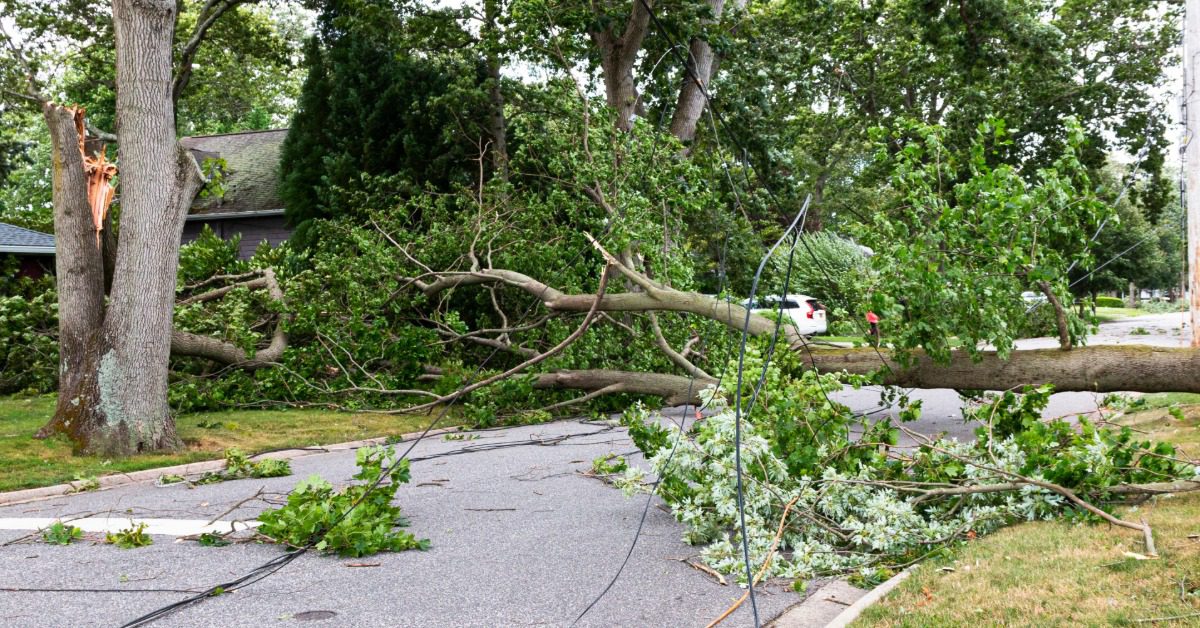
High winds knock down Omaha trees in stages. Compromised limbs fail when winds reach roughly 40 mph, large trees uproot at 55–63 mph, and nearly every trunk snaps around 90 mph. Saturated soil worsens these risks. Emergency tree removal in Omaha is necessary when a tree hits a structure, leans toward buildings or power lines, or shows root-plate heave.
Omaha sits in a corridor that sees serious windstorms on a schedule that most homeowners aren’t prepared to handle. Knowing these wind thresholds, the hidden hazards a storm leaves behind, and the exact triggers for a same-day call can keep your family safe and your mature trees standing for generations. Below, Great Plains Tree Care explains how high winds create emergency storm damage risks.
What Makes Omaha Trees Especially Vulnerable to Wind Damage?
Omaha sits in a derecho corridor and takes a hit roughly every two years, stacking repeated high-wind events on the same aging canopies.
- The July 31, 2024, windstorm caused the largest power outage in OPPD history, cutting service to more than 218,000 customers.
- The August 9, 2025, storm killed one person, knocked out power to nearly 40,000 customers, and forced the city to open multiple debris drop-off sites.
The region’s summer pattern compounds the problem. Heavy rain arrives first, then straight-line winds hit the already-soaked ground. Each storm also weakens surviving trees. A tree that loses a third of its canopy or takes a partial root lift in one August storm carries that damage into the next. As such, risk compounds year after year rather than resetting. Older neighborhoods with century-old trees carry both the highest character value and the highest risk of damage.
How Does Saturated Soil Make Trees More Likely To Fall?
Rain-soaked ground strips roots of their anchorage before the wind even peaks. Alabama Cooperative Extension describes fully saturated soil taking on a gravy-like consistency as the tree sways. Roots that hold firm in dry conditions lose their grip once the surrounding soil turns to slurry. The taller the tree, the more leverage the wind applies against that weakened anchor. This is why the largest trees in a yard often fail first in a rain-then-wind event.
Shallow-rooted species and trees in poorly drained low spots face the greatest saturation risk. Trees with roots confined by pavement, foundations, or compacted construction soil have even less anchorage to give up, making Omaha’s rain-then-wind sequence far more destructive than either factor alone.
Can a Tree Look Fine After a Storm and Still Be Dangerous?
The most dangerous storm damage is often invisible from the ground. High winds expose weaknesses that developed over years, creating emergency storm damage risks. A tree can pass a casual glance while hiding failures that drop limbs or topple the whole trunk weeks later.
Watch for the following delayed hazards:
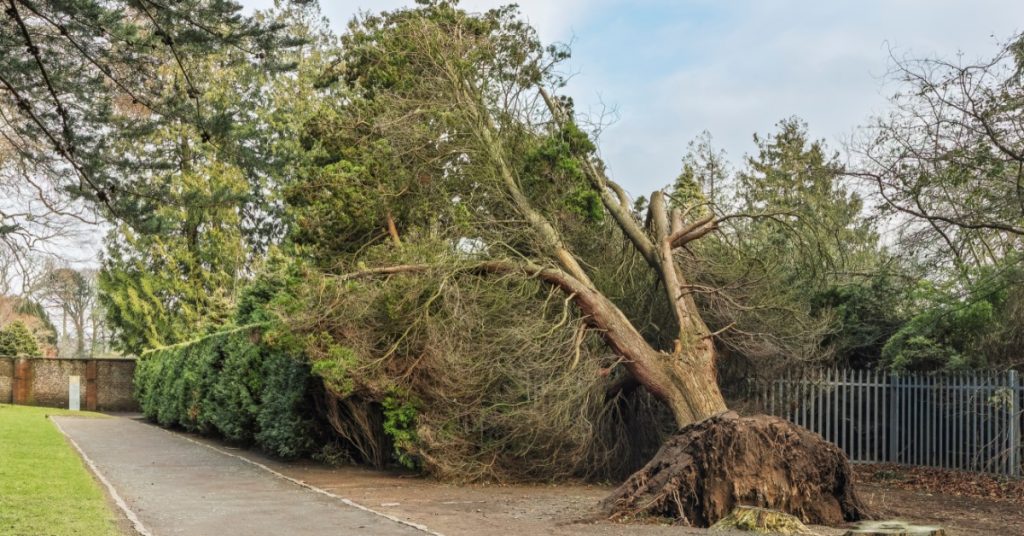
- Shifted or heaved root plates: This indicates that the tree has partially uprooted even while standing.
- Internal structural cracks and hidden decay: These signs of damage cause failure long after the storm passes.
- Hanging widow-maker limbs: These limbs are lodged in the canopy, waiting for wind, rain, or gravity to drop them without warning.
A certified arborist can read the small tells that a homeowner has no reason to notice: a fresh soil crack ringing the base, a slight new tilt against a fixed reference like a fence line, bark that has pulled loose on the inside of a bend. Catching these issues before they injure someone is the whole point of a professional post-storm inspection.
What Qualifies as an Emergency Tree Removal Situation?
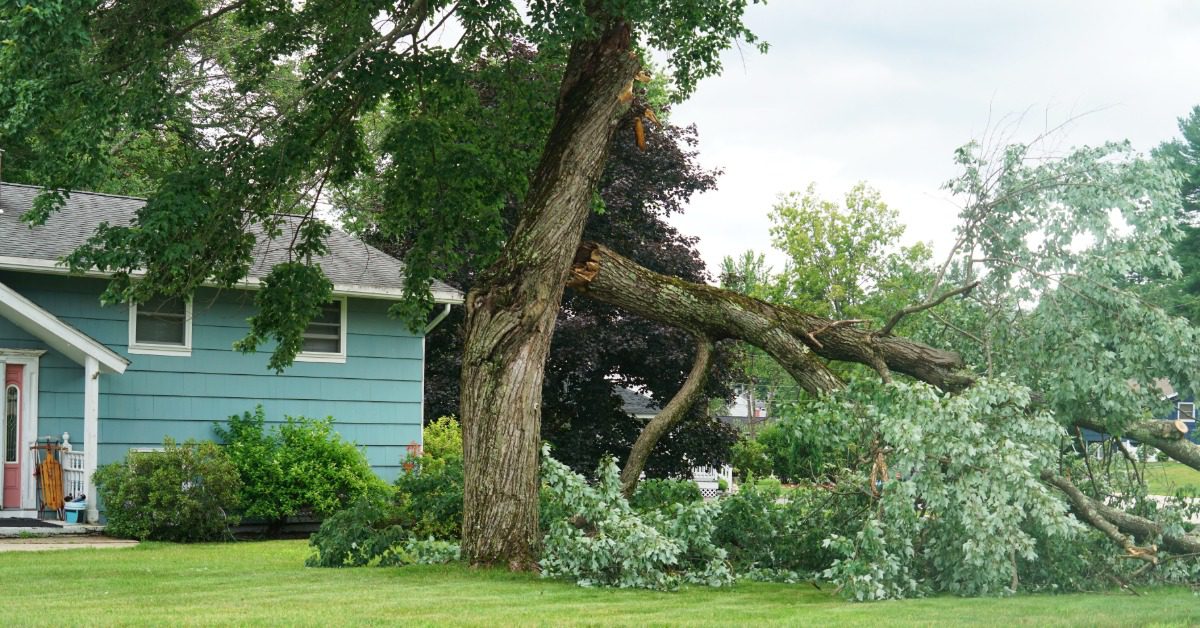
Emergency removal is mandatory when a tree or limb poses an urgent threat to people, property, or utilities.
Call for same-day emergency tree removal when:
- A tree has fallen on a house, garage, vehicle, or other structure
- A tree leans toward a building or power lines after the storm
- Visible root-plate heave shows that the tree is actively pulling out of the ground
- Major limbs hang over walkways, driveways, or occupied areas
- Any tree contacts power lines. This demands a coordinated response from utility crews and arborists and should never be a solo task.
Damage without an immediate threat can wait for a scheduled inspection. A split limb hung up over an unused corner of the yard still needs professional removal, but it doesn’t carry the same urgency as one hanging over a driveway you use every morning.
What Should You Do Immediately After a Storm Damages Your Trees?
Secure the area first, then document everything, and bring in a professional. Additionally, follow these safety guidelines:
- Keep people away from downed lines and leaning trees; assume every wire is live.
- Photograph all damage from multiple angles for insurance documentation before doing any cleanup.
- Address active hazards like broken or hanging branches right away, but postpone non-hazard pruning until an arborist evaluates the tree.
- Contact your insurer early to open a claim and confirm coverage.
- Call a certified arborist like Great Plains Tree Care for same-day response on emergency triggers; schedule an inspection for hidden-damage concerns.
Resist the urge to clean up a leaning trunk or a lodged limb before help arrives—moving one piece can release the tension holding everything else in place. Our tree removal service in Omaha handles emergency response and post-storm inspections.
Is It Safe To Remove a Storm-Damaged Tree Yourself?
No. DIY removal of storm-damaged trees is one of the most dangerous jobs a homeowner can attempt. Fallen trees hold stored tension. The wrong cut releases that force, and the trunk or limb shifts in a direction you cannot predict. A bent limb pinned under a fallen trunk can spring back with enough force to break bone. Chainsaw work that is performed overhead, on ladders, or near structures multiplies that risk further.
Any tree touching a power line requires utility coordination and trained crews. Certified arborists use rigging cranes and planned cut sequencing to control how stored tension releases.
FAQ
What is a derecho and how often does one hit Omaha?
A derecho is a widespread, fast-moving windstorm produced by a line of thunderstorms, capable of straight-line winds that mirror a hurricane. Omaha sees one roughly every two years.
Does homeowners’ insurance cover emergency tree removal in Omaha?
Coverage typically applies when a tree damages a covered structure, such as your home, garage, or fence. Photograph the damage and contact your insurer early, as thorough documentation improves claim outcomes.
How quickly does emergency tree removal need to happen?
Same-day removal is necessary when a tree strikes a structure, leans toward a building or power line, or shows root-plate heave. You can schedule an arborist evaluation for situations without an immediate threat.
How do I know if a tree is about to fall after a storm?
Look for a lifted or cracked root plate, soil heaving around the base, a new lean, fresh trunk cracks, and hanging limbs. Any of these indicators signal a tree that may fail without further warning.